
Your shopping cart is empty!

Shopping Cart
0 item(s) - Rs 0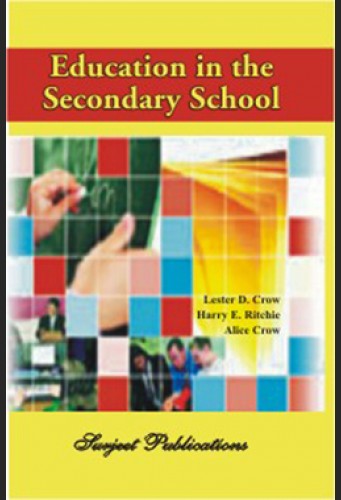
EDUCATION IN THE SECONDARY SCHOOL

- Product Code: 81-229-0232-4
- Availability: In Stock
- Price: Rs 325
- Ex Tax: Rs 325
Quantity:
Crow & Crow
Education in the Secondary School
The growing population of our secondary schools includes boys and girls who differ greatly in family background and ability to achieve academic success, as well as in educational and vocational interest and ambition. In Education in the Secondary School, we emphasize the functions of the school in relation to (1) the characteristics and educational needs of adolescents, (2) their lower-school background, (3) their post-high-school educational or vocational plans, and (4) the demands of society. Existing objectives, practices, and policies on the secondary–school level are interpreted and evaluated in the light of these functions.
In this book the various educational needs of secondary-school pupils are discussed in detail, and suggestions are offered for their fulfillment. Considered also are attempts to achieve educational continuity through improved articulation between school levels and among secondary-school learning materials. Attention is given to appropriate ways of implementing the changing secondary-school curriculum.
Since young people learn through their experiences, both in and outside the school, their activities should be guided carefully and intelligently. Obviously, secondary-school teachers exert great influence on the developing personalities of their pupils. For this reason the responsibilities of the various members of the school personnel are presented in detail. Desirable personality qualities are discussed, and the need for proper preservice and in service preparation is stressed. Moreover, since the extent to which a school can achieve its educational objectives depends on community encouragement and support, the treatment includes the importance of citizen attitudes toward an adequate budget and appropriate teaching-learning facilities.
Learner adjustment is a continuous and comprehensive process. The need for guidance is ever present; the authors therefore discuss the kinds of guidance that should be made available. Finally, suggestions are offered regarding the curriculum and teaching trends.
Write a review
Your Name:
Your Review:
Note: HTML is not translated!
Rating: Bad Good
Enter the code in the box below: