
Your shopping cart is empty!

Shopping Cart
0 item(s) - Rs 0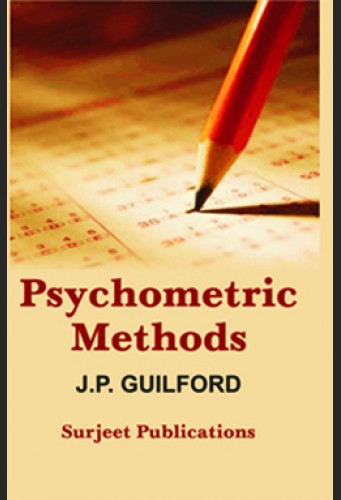
PSYCHOMETRIC METHODS

- Product Code: 81-229-0283-9
- Availability: In Stock
- Price: Rs 450
- Ex Tax: Rs 450
Quantity:
Psychometric Methods J.P. GUILFORD The purpose to bring out this edition has been to encompass within a single volume the various areas of psychological measurement and the statistical procedures attendant to them, as a guide to the graduate student. It was emphasized that experimental and statistical operations are intimately related, a point of view that seems now to be taken for granted. It was also emphasized that there is an essential unity among the different fields of psychological measurement that had grown up somewhat independently. That potential unity is clearer today. In this edition an attempt has been made toward further unifying steps in theory and in measurement and statistical operations. The introductory chapter attempts to base all psychological measurement on a general foundation of the logic of measurement. The second chapter lays the logical ground for psychophysical concepts and methods. A third chapter (Chap. 13) is devoted to the logical problems of psychological tests. Still another chapter (Chap.12) attempts to bring under a minimum number of principles a great many phenomena of human judgment, and in doing so depends very much on Helson’s concept of adaptation level. To make room for the enormous amount of new material and yet to keep the length of this volume within reasonable bonds, it was necessary to eliminate most of the statistical treatments given in the first edition. This was done by depending very much upon the author’s Fundamental Statistics in Psychology and Education. Even with the statistical eliminations, it has been necessary to be very selective in the incorporation of new material. Some of the readers will look for, and miss, general references to information theory and methods. While the writer recognizes the merits of these new ideas, and that they may well have revolutionary effects upon psychological measurement.
Write a review
Your Name:
Your Review:
Note: HTML is not translated!
Rating: Bad Good
Enter the code in the box below: